
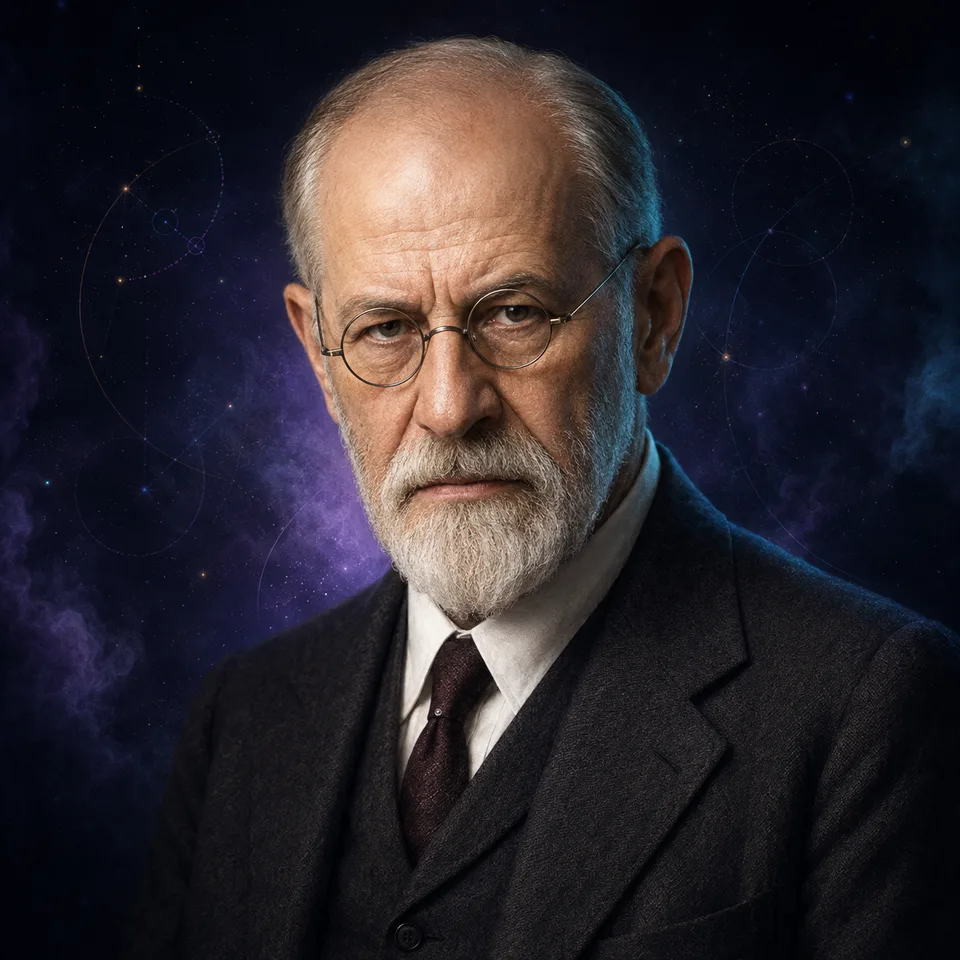
Sigmund Freud
1856, Freiberg — 1939, London
Biography
Freud trained in medicine and neurology in Vienna, studied nervous disorders, and gradually developed psychoanalysis through clinical work and collaboration with Josef Breuer. He emphasized unconscious conflict, childhood experience, resistance, transference, and speech in treatment.
After Nazi Germany annexed Austria in 1938, Freud and his family fled Vienna for London. His theories transformed psychiatry, literature, art, and popular culture, while many specific claims remain disputed or weakly testable by contemporary scientific standards.
Sigmund Freud must be understood within a specific historical setting rather than as a timeless voice detached from institutions, languages, and debates. The surviving chronology places this austrian neurologist and founder of psychoanalysis between 1856, Freiberg and 1939, London. Those dates matter because ideas about dreams changed with medicine, theology, philosophy, publishing, and the audiences for whom books were written. A responsible biography therefore separates evidence contemporary with the subject from later anecdotes, popular legends, translations, and commercial editions that may have enlarged the person’s reputation.
The intellectual career associated with Sigmund Freud cannot be reduced to dream interpretation alone. The biographical record shows how education, professional networks, patrons, patients, students, religious communities, or scholarly disputes shaped the questions that became important. Even when later readers remember one famous theory, the original work belonged to a wider programme of inquiry. Reading that career in sequence helps explain why concepts changed over time and why a mature publication should not automatically be projected backward onto every earlier stage of the author’s life.
The principal works preserved or associated with this profile include Die Traumdeutung (The Interpretation of Dreams) (1899/1900)؛ Drei Abhandlungen zur Sexualtheorie (1905)؛ Das Ich und das Es (The Ego and the Id) (1923). Titles alone, however, do not establish what the author believed. Their publication dates, genres, intended readers, manuscript transmission, editorial history, and translations all affect interpretation. In this case, the accompanying bibliographical record notes: His foundational account of dream-work and interpretation. Three Essays on the Theory of Sexuality. A later structural model of the psyche. Comparing editions and scholarly catalogues is especially important when attribution is uncertain or when a work became famous through a translation that used a vocabulary different from the original language.
Sigmund Freud’s approach to dreams is best described as a method, not a list of interchangeable symbols. The Interpretation of Dreams distinguishes remembered manifest content from latent dream-thoughts. Free association follows the dreamer’s own links; condensation, displacement, representability, and secondary revision describe “dream-work.” Freud did not recommend a simple universal dictionary. This distinction prevents a common error: taking a single image out of its narrative and assigning it a universal verdict. The dreamer’s circumstances, sequence of events, emotion, language, and response may change the reading. Historical methods can be studied seriously without treating them as experimentally proven, while psychological methods can inform reflection without turning a dream into a clinical diagnosis.
Reception is part of the biography because later generations continually reconstructed Sigmund Freud. Students, editors, clinicians, religious scholars, artists, and popular publishers selected different parts of the legacy. Freud made dreams central to a theory of mind and clinical conversation. His historical influence is enormous, but modern sleep science does not accept every dream as disguised wish-fulfilment, and interpretation is not diagnosis. The result is both influence and distortion: memorable labels often travel farther than the qualifications in the original works. This page therefore uses named reference points—Freud Museum London — The Interpretation of Dreams؛ Encyclopaedia Britannica — Sigmund Freud—so readers can distinguish documented biography from interpretation. Sources themselves may disagree, and that disagreement should be shown rather than concealed behind a simplified heroic story.
Approach to dreams
The Interpretation of Dreams distinguishes remembered manifest content from latent dream-thoughts. Free association follows the dreamer’s own links; condensation, displacement, representability, and secondary revision describe “dream-work.” Freud did not recommend a simple universal dictionary.
Principal works
- Die Traumdeutung (The Interpretation of Dreams) (1899/1900) — His foundational account of dream-work and interpretation.
- Drei Abhandlungen zur Sexualtheorie (1905) — Three Essays on the Theory of Sexuality.
- Das Ich und das Es (The Ego and the Id) (1923) — A later structural model of the psyche.
Legacy and limits
Freud made dreams central to a theory of mind and clinical conversation. His historical influence is enormous, but modern sleep science does not accept every dream as disguised wish-fulfilment, and interpretation is not diagnosis.
✦ Key Dream Symbols & Archetypes
Prominent dream images and archetypes central to this thinker’s interpretive methodology: