Why Dream Dictionaries Cannot Give Everyone the Same Meaning
Dream dictionaries can be interesting, but fixed meanings ignore personal experience, culture, emotions and dream context. Learn why contextual interpretation is different.
Dream dictionaries are appealing for one simple reason: they make a complicated experience feel easy to decode.
Dream of a snake? Look up “snake.”
Dream of losing teeth? Look up “teeth.”
Dream of water? Find “water.”
The problem is not that symbolic traditions are worthless. They can be culturally interesting and may give a dreamer ideas to consider.
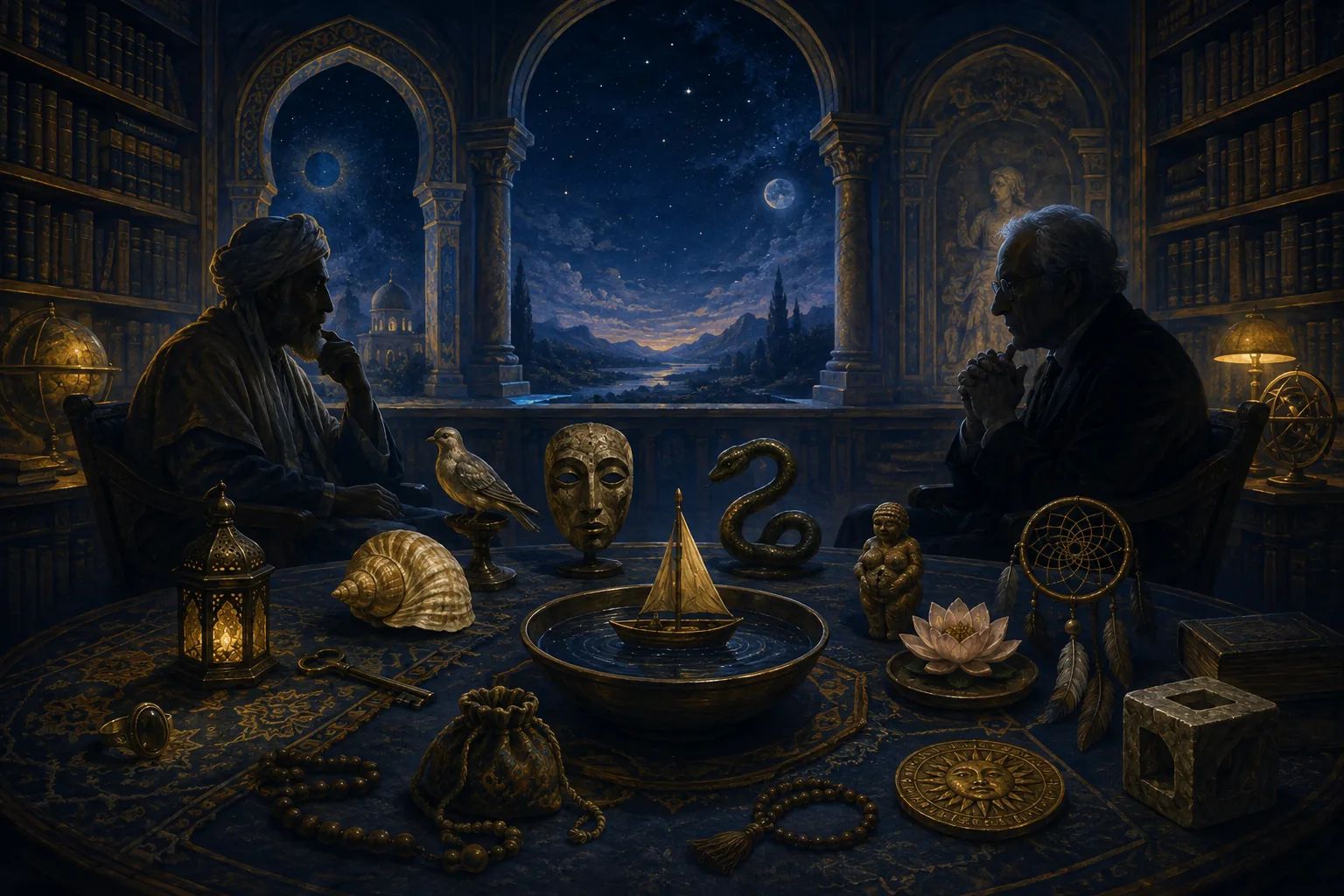
The problem begins when a possible association is presented as a universal fact. As explored in depth in our pillar analysis of why dream symbols do not have one universal meaning, treating cultural metaphors as universal constants misconstrues how the brain generates nocturnal imagery.
The Dictionary Model
A fixed dream dictionary usually works like this:
Symbol → Meaning
For example:
- snake → betrayal;
- water → emotion;
- flying → freedom;
- falling → loss of control;
- death → transformation.
That model assumes the object itself contains enough information to identify what the dream means.
But dream research gives us strong reasons to consider more information. In the psychology of dream symbols, an object's affective atmosphere often matters far more than its objective form.
Dream content is related to waking experiences, memories, emotional concerns, and individual differences.
Example: A Snake Is Not Just a Snake
Imagine four dreams.
Dream A: A snake attacks the dreamer in a dark room.
Dream B: The dreamer gently picks up a pet snake.
Dream C: A biology student dreams about identifying a snake species.
Dream D: A snake appears during a religious or culturally meaningful ritual.
The same noun appears in all four reports.
But almost everything psychologically relevant is different.
Reducing all four to:
Snake = betrayal
throws away the majority of the information.
Context Changes Meaning
A more useful model is:
Symbol + event + emotion + personal association + waking context
If someone dreams of a house, we might ask:
- Whose house was it?
- Was it familiar?
- Was the dreamer trying to enter or escape?
- Was it safe or threatening?
- Does the house exist in waking life?
- What memories are connected to it?
A childhood home may have entirely different associations from an unknown abandoned building.
The category “house” alone cannot capture this.
Dream Content Reflects Individual Experience
The continuity hypothesis proposes that waking-life experiences and concerns are reflected to varying degrees in dreams.
Research broadly supports relationships between waking life and dream content, while also showing that incorporation is selective rather than literal.
This helps explain why the same symbol can have different significance across different people.
Your brain has access to your memories.
Your history.
Your relationships.
Your fears.
Your routines.
Your culture.
A generic dictionary has access to none of those unless you provide them.
Culture Adds Another Layer
Dream interpretation traditions differ substantially across societies, religions, historical periods, and schools of psychology.
Cross-cultural research has found both commonalities and differences in dream content.
That does not mean culture explains every dream.
It does mean that symbols cannot automatically be separated from the interpretive world in which a person lives.
Why Dream Dictionaries Still Feel Accurate
There are several reasons a general interpretation may feel personally meaningful.
First, many dictionary meanings are broad.
Terms such as:
- change;
- fear;
- conflict;
- opportunity;
- relationships;
- uncertainty;
could apply to many people's lives at many different times.
Second, people naturally search for connections between new information and their own experience.
Third, some themes really are common in human life.
None of this proves that the proposed meaning was encoded inside the dream symbol.
A useful interpretation should therefore remain open to alternatives.
A Better Way to Use a Dream Dictionary
A dream dictionary can still be used as an idea generator.
Instead of:
“The dictionary says a snake means betrayal, therefore my dream means betrayal.”
try:
“Betrayal is one traditional association. Does that interpretation fit anything about the dream, my feelings, or my current life?”
If the answer is no, there is little reason to force it.
The distinction is: possibility vs certainty.
Five Questions to Ask Before Accepting a Symbol Meaning
1. What happened around the symbol?
A symbol without its narrative may be misleading.
2. What emotion did you feel?
Fear, curiosity, sadness, relief and excitement can point in very different directions.
3. What does this thing mean to you personally?
Your first association may be more informative than a generic entry.
4. Is there a recent waking-life connection?
Recent experiences can appear directly or indirectly in dreams.
5. Are you treating an interpretation as a hypothesis or a fact?
Dream interpretation rarely provides the kind of verification available in a laboratory measurement.
Dream Dictionaries vs Contextual Interpretation
Fixed dictionary approach
Input: Snake
Output: Betrayal
Contextual approach
Input:
- snake;
- childhood home;
- no fear;
- trying to protect it;
- recent conversation about caring for an injured animal.
Output: Several interpretations may now be worth exploring.
The second approach does not guarantee truth. Its advantage is that it respects more of the actual dream.
When a Dream Is Disturbing
Dream interpretation should not be confused with diagnosis.
Frequent severe nightmares can be clinically relevant, and nightmare disorder is recognized in sleep medicine. Nightmares commonly involve disturbing dream experiences and often occur during REM sleep.
But a symbol inside a dream is not, by itself, evidence of a psychiatric disorder.
The Bottom Line
Dream dictionaries can preserve cultural traditions, provide prompts for reflection, and introduce possible associations.
Their limitation is the assumption that one symbol can reliably produce one meaning without knowing the person or the dream.
A more careful approach treats symbolic meanings as possibilities and asks whether they fit the dreamer's actual context. Explore our curated Dream Science Knowledge Hub for additional research-grounded perspectives.
Try Context Before Certainty
When describing your dream to Razita, include:
- the full scene;
- your feelings;
- what happened before and after the symbol appeared;
- any personal connection you have to the symbol.
The richer the context, the less interpretation depends on a one-line dictionary entry. Test your contextual dream descriptions in our live dream simulator.
Suggested references
- Schredl M, Hofmann F. Continuity between waking activities and dream activities. Consciousness and Cognition. 2003. DOI: 10.1016/S1053-8100(02)00072-7.
- Domhoff GW, Schneider A. Similarities and differences in dream content at the cross-cultural, gender, and individual levels. Consciousness and Cognition. 2008. DOI: 10.1016/j.concog.2008.08.005.
- Schredl M. Characteristics and contents of dreams. International Review of Neurobiology. 2010. DOI: 10.1016/S0074-7742(10)92007-2.
Experience Your Own Dream Analysis
Connect your nocturnal visions with the scientific insights of Freud, Jung, and classical interpreters. Test Razita's conversational simulator right now.
✦ Interpreters & Schools Discussed in this Article
The theoretical frameworks of these thinkers provide foundation for this analysis:


✦ Key Dream Symbols Mentioned
In-depth psychological and historical interpretations of symbols featured in this article: