Is There Scientific Evidence for Dream Interpretation?
Does science support dream interpretation? Learn what research says about dream content, memory, emotions, waking-life experiences, and the limits of symbolic interpretation.
Dreams can feel deeply meaningful. A person may wake from a dream about an old friend, a falling building, a snake, or a childhood home and immediately wonder whether it is trying to say something.
Science gives a more nuanced answer than either “dreams are meaningless” or “every dream contains a hidden message.”
Research provides substantial evidence that dream content can reflect memories, emotions, personal concerns, recent experiences, and ongoing cognitive processes. What science has not established is a universal decoding system in which a specific image always has the same psychological meaning for every person. The critical question of whether dream symbols have universal meanings remains a clear divide between empirical findings and folk traditions.
That distinction is essential.
What Dream Science Can Actually Study
Dream research does not require scientists to decide whether a dream “means” one particular thing.
Researchers can investigate measurable questions such as:
- whether waking experiences appear in dreams;
- whether emotionally important events are more likely to be incorporated;
- whether newly learned information appears in dream reports;
- whether dream content differs across people or cultures;
- how dream reports change across sleep stages;
- whether dreaming about a learning experience is associated with later memory performance.
One of the best-supported ideas in modern dream research is the continuity hypothesis: aspects of waking life tend to be reflected in dreams.
Studies by Michael Schredl and colleagues have found relationships between waking activities, concerns, and subsequent dream content, although not every waking experience is incorporated equally. Emotional involvement appears to matter.
This does not mean dreams reproduce daily life like a video recording. They often reorganize people, places, memories, and emotions into combinations that never occurred while awake.
Dreams and Memory
The relationship between dreaming and memory is one of the strongest areas of empirical dream research.
Sleep itself is important for memory consolidation: newly acquired information can be reactivated and reorganized while we sleep. Dream content sometimes appears to reflect those processes.
A 2023 meta-analysis examined studies in which participants learned something before sleeping and were later tested on their memory. Across the included studies, dreaming about the learning task was associated with better post-sleep memory performance.
Importantly, this does not prove that the dream itself caused the memory improvement. Dream content may instead provide a window into underlying memory-processing activity occurring during sleep.
This is very different from saying:
“If you dream about a school, it means you fear failure.”
Science may support a relationship between dreams and memory processing without supporting a fixed symbolic translation.
Dreams and Emotion
Dreams are also closely connected with emotion.
Emotional experiences from waking life frequently influence dream content, and many dreams—particularly vivid or disturbing ones—contain strong emotional material.
Research examining sleep, REM sleep, dreams, and emotional processing suggests important connections between these systems. However, scientists are still investigating exactly what role dreaming itself plays, as distinct from the underlying neurobiology of sleep.
It is therefore reasonable to say:
Dreams can reflect emotionally significant material.
It is much less defensible to say:
A particular dream symbol has one scientifically proven emotional meaning.
Those are two very different claims.
Does Science Support Dream Symbols?
Scientific dream research can identify statistical patterns in dream content.
Researchers may find, for example, that certain themes, social interactions, emotions, threats, or waking concerns appear more often in particular populations.
But population-level patterns are not equivalent to a dictionary. The psychology of dream symbols demonstrates that the identical image carries fundamentally disparate meanings across individuals.
Research has also found both similarities and differences in dream content across cultures and individuals.
Consider a snake.
For one person, a snake may be associated with fear.
For another, it may remind them of a pet.
For someone studying biology, it may simply reflect recent work.
For another person, its significance may come from a religious or cultural tradition.
Without knowing the dreamer's associations and the rest of the dream, automatically assigning one meaning removes much of the information that could actually matter.
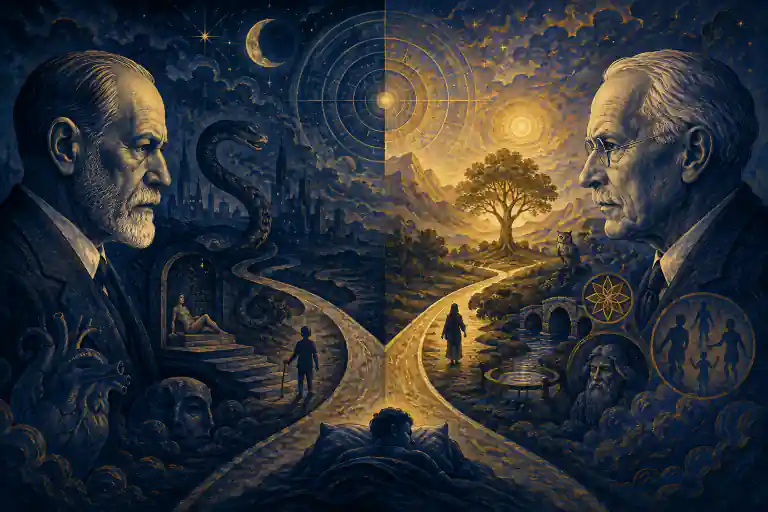
What About Freud and Jung?
Freud and Jung profoundly influenced how modern culture talks about dreams.
Both proposed theories in which dream material could carry psychological significance, but their frameworks are not equivalent to contemporary experimental dream science. In our comparison of Freud, Jung and modern dream research, we trace how clinical intuition evolved into laboratory paradigms.
Modern researchers can test questions about sleep stages, memory, emotional processing, dream frequency, dream content, and waking-life continuity using experiments, longitudinal studies, dream diaries, neuroimaging, and statistical analysis.
Claims about an unconscious symbolic code are much harder to test.
Contemporary reviews comparing psychoanalytic ideas with empirical dream research find some areas of possible convergence while also showing that many historical theoretical claims cannot simply be treated as established scientific findings.
So Is Dream Interpretation Scientific?
It depends on what we mean by “interpretation.”
If dream interpretation means:
Every symbol has a predetermined meaning that can be looked up in a universal dictionary,
current scientific evidence does not establish such a system.
If it means:
Exploring a dream in relation to the dreamer's memories, emotions, current concerns, personal associations, and life context,
then that approach is more compatible with what empirical dream research tells us about the relationship between dreaming and waking experience.
Even then, the result should normally be treated as an interpretation or hypothesis, not as an objective diagnosis.
A Better Question Than “What Does This Symbol Mean?”
Instead of asking:
What does a snake mean in dreams?
try asking:
What did the snake mean to me in this particular dream?
Then consider:
- What was happening around it?
- What emotion did you feel?
- Did it remind you of anything from waking life?
- Has the image appeared before?
- What was happening in your life before the dream?
- Was the symbol threatening, protective, neutral, familiar, or strange?
The symbol alone may provide little information.
The relationship between the symbol, the dreamer, and the surrounding context may tell us much more.
The Bottom Line
Science has found meaningful relationships between dreaming and waking experiences, memory, emotion, and cognition.
What science has not produced is a validated universal dictionary capable of translating every dream image into one fixed psychological meaning.
Dreams can be worth exploring without pretending that interpretation is certainty. For a structured overview of this discipline, visit our Dream Science Hub.
Explore Your Dream in Context
If you want to explore a dream with Razita, describe not only what happened but also what you felt, what stood out, and what was happening in your life around the time of the dream. You can test your personal narrative directly in our interactive dream reflection simulator or reference individual motifs in the dream symbol explorer.
The goal is not to declare one hidden truth. It is to explore plausible interpretations in context.
Suggested references
- Schredl M, Hofmann F. Continuity between waking activities and dream activities. Consciousness and Cognition. 2003. DOI: 10.1016/S1053-8100(02)00072-7.
- Hudachek L, Wamsley EJ. A meta-analysis of the relation between dream content and memory consolidation. Sleep. 2023. DOI: 10.1093/sleep/zsad111.
- Wamsley EJ. Dreaming and offline memory consolidation. Current Neurology and Neuroscience Reports. 2014. DOI: 10.1007/s11910-013-0433-5.
- Domhoff GW, Schneider A. Similarities and differences in dream content at the cross-cultural, gender, and individual levels. Consciousness and Cognition. 2008. DOI: 10.1016/j.concog.2008.08.005.
- Roesler C. Dream interpretation and empirical dream research. International Journal of Psychoanalysis. 2023. DOI: 10.1080/00207578.2023.2184268.
Experience Your Own Dream Analysis
Connect your nocturnal visions with the scientific insights of Freud, Jung, and classical interpreters. Test Razita's conversational simulator right now.
✦ Interpreters & Schools Discussed in this Article
The theoretical frameworks of these thinkers provide foundation for this analysis:


✦ Key Dream Symbols Mentioned
In-depth psychological and historical interpretations of symbols featured in this article: