Can AI Interpret Dreams? What AI Can—and Cannot—Know
AI can analyze dream narratives and identify themes, but it cannot objectively decode hidden meanings. Learn how contextual AI dream interpretation can be useful—and where its limits are.
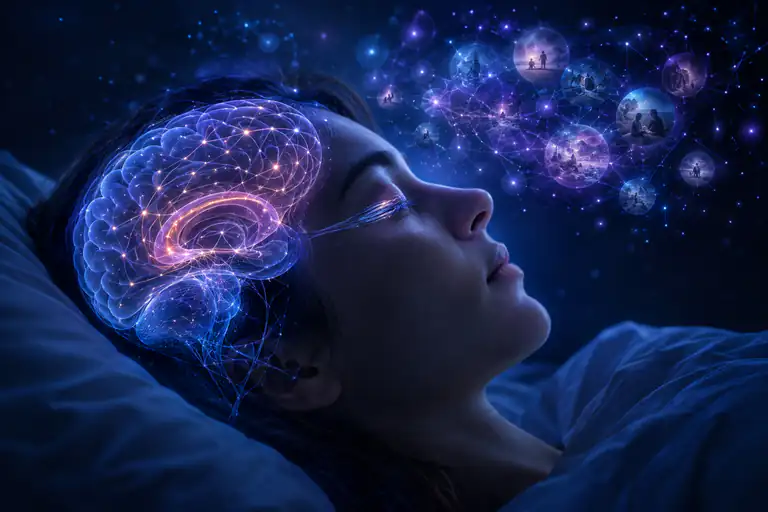
Artificial intelligence can read a detailed dream description in seconds.
It can identify people, places, emotions, repeated themes, possible associations, and similarities with psychological or cultural interpretations.
That makes AI unusually well suited to helping people explore dreams.
But there is an important boundary:
AI cannot scientifically verify that one hidden interpretation of a dream is objectively correct.
The distinction between exploration and certainty determines whether AI dream interpretation is useful or misleading.
What AI Is Good At
Modern language models are designed to analyze relationships in language and generate context-sensitive responses.
For dream exploration, that can be useful.
An AI system can compare information across a long dream narrative.
For example:
“I was walking through the school I attended as a child. The building was empty. I found my father's watch in a classroom, but I felt calm rather than afraid.”
A contextual system can notice that the dream includes:
- childhood;
- a specific location;
- a family relationship;
- an emotionally significant object;
- absence or emptiness;
- an unexpectedly calm emotional response.
That is far richer than reducing the entire dream to:
Watch = time.
AI Can Ask Better Questions
One of AI's most useful roles may not be giving answers.
It may be asking questions.
For example:
- What does your father's watch mean to you personally?
- Was the school a positive or difficult place in your life?
- Did anything recently remind you of your father?
- Did the calm feeling surprise you?
- Have similar locations appeared in previous dreams?
These questions provide additional context.
And context matters because empirical dream research finds relationships between dream content and waking experiences, memories, emotions, and personal concerns. Reviewing why personal associations matter shows that meaning lives in autobiographical memory rather than an objective index.
AI Does Not Have Access to a Universal Dream Decoder
No scientifically validated database exists in which:
symbol + dream = objectively proven meaning
In accordance with what scientific dream research can establish, evidence exists for processes such as:
- waking-life incorporation;
- memory consolidation;
- emotional content;
- sleep stages;
- recurring patterns in dream reports.
But this is different from proving that:
Snake always means betrayal.
or:
Water always represents suppressed emotion.
As documented in the limitations of fixed dream dictionaries, an AI system that states such interpretations as facts is displaying false certainty and mimicking an unscientific universal symbolic code.
AI Can Combine Multiple Interpretive Frameworks
One advantage of AI is that it can keep different interpretive traditions separate.
A useful system might say:
Traditional interpretation: A particular symbol has historically been associated with X.
Jungian interpretation: A Jungian framework might explore Y.
Psychological/contextual interpretation: The dreamer's own association may suggest Z.
Scientific evidence: Research supports certain relationships between dreaming, waking experience, memory or emotion—but does not validate one fixed symbolic meaning.
The categories should not be blended together.
A traditional belief is not automatically a scientific finding.
A Jungian interpretation is not automatically a diagnosis.
A possible psychological interpretation is not automatically a fact.
Why AI Can Still Get Dream Interpretation Wrong
Large language models can generate fluent answers that sound authoritative even when the underlying claim is unsupported.
Systematic reviews of LLMs used in mental-health-related contexts have identified concerns including hallucinated information, inconsistency, bias, privacy, and overreliance.
This matters for dream interpretation.
An AI might confidently produce:
“This dream proves you have unresolved childhood trauma.”
That is not an appropriate conclusion from a dream report.
Or it might say:
“Dreaming about death means you are clinically depressed.”
Again, the dream alone cannot establish that diagnosis.
AI-generated dream analysis should therefore distinguish carefully between:
- observation
- possible interpretation
- traditional symbolism
- research finding
- clinical diagnosis
AI Should Not Diagnose Mental Health Conditions From Dreams
Dream content can be interesting to psychologists and sleep researchers, and certain sleep disorders involve clinically relevant dream phenomena.
For example, recurrent distressing nightmares can be clinically important.
But AI should not infer psychiatric diagnoses from individual dream symbols.
LLM research in mental-health applications remains promising but incomplete, and reviews continue to identify risks in unsupervised clinical use.
A responsible dream tool should therefore avoid statements such as:
“You have PTSD because you dreamed about being chased.”
or:
“This dream confirms depression.”
Dream exploration and medical diagnosis are different tasks.
Privacy Matters
Dreams can contain unusually personal information.
People may describe relationships, sexual content, fears, family conflict, traumatic memories, work, medical concerns, names, and locations.
Any AI dream service should therefore treat privacy as a core product consideration rather than an afterthought.
Users should also consider whether personally identifying details are necessary before including them in a dream description.
What a Better AI Dream Interpreter Looks Like
A responsible AI dream-analysis process might work like this:
Step 1: Understand the narrative
Identify characters, locations, events, objects, emotions, and recurring themes.
Step 2: Ask for personal context
For important elements: What does this remind you of? What did you feel? Is there a recent connection?
Step 3: Separate frameworks
Clearly distinguish personal interpretation, cultural/traditional symbolism, historical psychological theories, and empirically supported findings.
Step 4: Generate possibilities
Use language such as “One possibility is…” rather than “Your dream definitely means…”
Step 5: Preserve uncertainty
Sometimes there is not enough information. A useful AI should be able to say so.
Can AI Discover Patterns Across Multiple Dreams?
This is potentially more interesting than decoding a single symbol.
With a series of dream reports, an AI system may be able to help users identify recurring:
- people;
- locations;
- emotional patterns;
- themes;
- conflicts;
- motifs.
For example, a person might discover that dreams involving work repeatedly contain urgency, missed deadlines and being unable to find something.
That pattern may be more informative for self-reflection than searching a dictionary entry for “office.”
Research on waking-life continuity also makes repeated patterns an interesting area to explore, although detecting a pattern still does not prove one hidden psychological cause.
Researchers Are Already Using AI to Study Dreams
AI is not only being used for consumer dream interpretation.
Researchers have begun applying large language models to the scientific analysis of dream reports. A recent study, for example, used an LLM to help examine patterns in dreams across healthy and clinical populations.
This illustrates an important distinction:
AI can be useful for analyzing dream data without possessing a magical ability to know what every dream objectively means.
The Best Role for AI: Interpretation Assistant, Not Dream Oracle
AI's strongest advantage is scale and context.
It can process a complex narrative, remember details within the conversation, compare possible interpretations, ask follow-up questions and explain different frameworks.
Its weakness is certainty.
A responsible system should never pretend that fluent language equals scientific proof.
The ideal model is therefore:
Dream + emotion + personal associations + waking context + patterns → plausible interpretations
not:
Symbol → guaranteed meaning
How Razita Approaches Dream Exploration
When you use Razita, give the system as much useful context as you are comfortable sharing. You can interactively test this in our conversational dream simulator or explore curated motifs in the dream symbol explorer.
Instead of:
“I dreamed of a dog. What does it mean?”
try:
“I dreamed that my childhood dog was waiting outside my old house. I felt happy but also knew I couldn't go inside.”
The second description contains emotional, autobiographical and narrative information.
That gives AI something meaningful to analyze beyond a single keyword.
Dream interpretation is most useful when AI helps you explore possibilities—not when it pretends to know a hidden truth with certainty. For further background on our research methodology, visit the Dream Science Hub.
Suggested references
- Schredl M, Hofmann F. Continuity between waking activities and dream activities. Consciousness and Cognition. 2003. DOI: 10.1016/S1053-8100(02)00072-7.
- Xu X et al. Large Language Models for Mental Health Applications: Systematic Review. IEEE Access. 2024.
- Hua Y et al. A scoping review of large language models for generative tasks in mental health care. npj Digital Medicine. 2025. DOI: 10.1038/s41746-025-01611-4.
- Perogamvros L et al. The cathartic dream: Using a large language model to study a new type of functional dream in healthy and clinical populations. Journal of Sleep Research. 2024. DOI: 10.1111/jsr.70001.
Experience Your Own Dream Analysis
Connect your nocturnal visions with the scientific insights of Freud, Jung, and classical interpreters. Test Razita's conversational simulator right now.
✦ Interpreters & Schools Discussed in this Article
The theoretical frameworks of these thinkers provide foundation for this analysis:

✦ Key Dream Symbols Mentioned
In-depth psychological and historical interpretations of symbols featured in this article: